
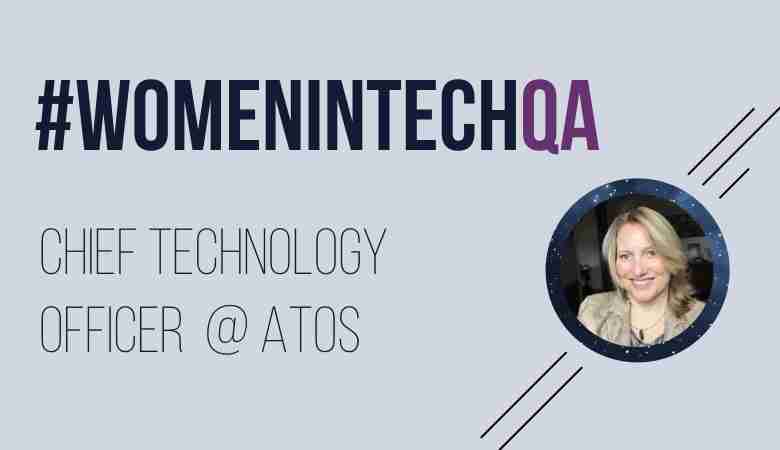
In the latest instalment of our #WomenInTechQA series, we caught up with Eltina Ouwehand, Chief Technology Officer (CTO) at Atos, to talk about some of the biggest challenges women face in the technology industry and how these can be overcome.
Eltina Ouwehand describes her own experience in the technology industry, as well as providing potential reasons that explain why women, particularly in the Netherlands, are less likely to pursue a career in tech. She also gives some advice for those thinking about considering a career in the tech industry.
Third Republic (TR): You’ve had an incredibly successful career in tech, so could you tell us a bit about how you got started in tech and what made you want to pursue a career in the industry?
Eltina Ouwehand (EO): I’m not particularly from a tech background, but I started in an insurance company, which is similar to a tech company, because you hardly have any products you can touch, it’s all in computers or in systems. I began as a Process Manager and I ended up as an IT Consultant, Program Manager, Project Manager, before becoming the Chief Information Officer (CIO), which is more a role in-between IT and business. After thirteen years in this company, I wanted to do something a bit different, so I moved to Atos, and I’ve been working there for eight years now.
Although I’m not a real techie, I know exactly what they need, how they behave and what is important for them. Whilst working at Atos, I saw a lot of things internally that needed changing and I became the Competence Manager for the Professional Services Department, for this you need to have knowledge not only about technology, but also stakeholder management, how to analyse the environment, as well as considerable social skills. From there I became Chief Technology Officer (CTO), which mainly involves determining the company strategy surrounding which technologies are more important for us as Atos, but also for our customers.
Alongside CTO, I am also the Head of Innovation, at the forefront of all developments in the world of IT. This is very fast paced, because unlike if you study literature, or history where after 20 years, your knowledge is still valuable, in IT, after a year of not learning, your knowledge significantly reduces in value.
One thing I have noticed during my career, is that in the tech industry, particularly on the consultant side, there are less women. I consider this to be such a pity, because there is so much opportunity available for women to explore and to be valuable in this area.
TR: What are some of the biggest challenges, if any, you have faced throughout your career in a traditionally male-dominated industry and how did you tackle these?
EO: It’s a bit of a generalization, but what I see myself, is that women want to please, and in order to achieve this they tend to forget about themselves. I have a lot of female students in my teams and what I always suggest is; be yourself, if you think something isn’t the best solution, don’t do it and stand up for yourself.
I think one of the biggest challenges for women is to overcome themselves. It took me almost 20 years to develop myself to a point where I think, ‘I’m here and these are my experiences, and you can think what you want, but this is my experience, so we do it this way.’ Something that enabled me to reach this point were role models. When I was a starting consultant, the CIO was a woman, and it was so important for me to see that it wasn’t only men who were in these high level positions. Women are always underestimating themselves, and we just need to be a bit more confident.
It’s culture, it’s history, it’s climate and it’s opportunity.
{{cta(‘fbcdff54-3ae9-4ae5-9d89-32b7a006e0f7′,’justifyleft’)}}
TR: In your experience, why do you think women are less likely to take up careers in tech?
EO: From my experience, I would say that it starts at school. In the Netherlands, for instance, schools get paid for every scholar that passes their diploma. Most of the girls are better at languages than in mathematics or physics, not that they are bad at it, but their grades are lower. As a result, the girls are encouraged into languages and the social science path, and are not stimulated in mathematics or physics.
When we bring in scholars from secondary schools to Atos, to show them demonstrations, I see that most of the students on the tech path are boys, so at that point you are already leaving the girls behind. So for me it all starts in school.
TR: How do you think we can encourage more women to take up careers in the tech space?
EO: [Linking back to the previous question] I tell girls that if you study language, it’s a good platform to make the step into IT software development, because what are you doing? You are building languages! There are a lot of similarities between a language from a country and a language in a computer system, but if nobody tells them they never look at an IT company or an ICT education.
TR: Role models are important in any career, so how do you think that shining a light on successful women working in tech will help to improve diversity in the industry?
EO: Role models are very important, because a lot of people and particularly children, learn by copying, if people only see men, then only men will get involved in tech and that’s why it is important to have more representation in the tech world.
While a lot of men think; ‘I’m so important because I am the CIO or the CEO look at me and how important I am’, that’s not a specific driver for women to be in tech, they are in tech because they like it and they have experience. But sometimes we have to stand up and take the stage and say’ ‘Oh, we are there. You don’t see us all the time, but we are there. So look at us and see what’s happening.’
TR: In your opinion, how can businesses and communities work towards improving female representation in the tech world?
EO: Give women a stage, promote them. Inside, but also outside your own business and community. You have to encourage them, mostly women are not willing, or they are a bit shy so you have to give them the confidence to do things.
One of my leads, in one of my tech labs is also a woman, and she’s a bit afraid to speak English so she won’t give presentations in English. But I encourage her to do it, because otherwise she would miss all these opportunities to speak with international customers, and that’s a pity because she’s brilliant!
TR: Finally, what’s the best piece of advice that you’ve received throughout your career that might help others navigating their own journey to a career in tech?
EO: My advice is go for it, just do it, don’t doubt yourself, and make sure you make mistakes because that is the best way to learn.
If you’d like to be involved in our next Q&A, get in touch with us today!


