
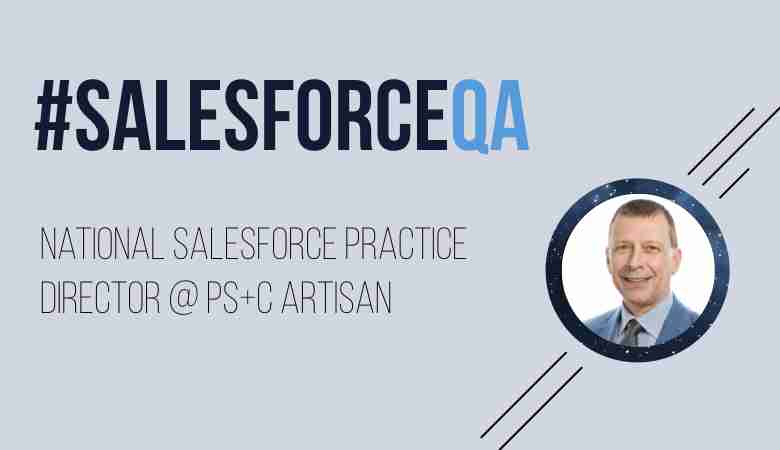
In our most recent Salesforce Q&A, we caught up with Richard Clarke, National Salesforce Practice Director at PS+C Artisan.
Richard talks to us about some of the benefits and challenges of becoming an architect in the ecosystem, reveals the key traits that are needed for success in the ecosystem, and discusses the skills gap in Salesforce talent.
Third Republic (TR): Could you talk us through the beginning of your career and how you got into a career the Salesforce ecosystem?
Richard Clarke (RC): I started out working with Microsoft technologies before I was introduced to Salesforce. At the time, I was really impressed with how easy it was to create business applications with the Salesforce platform. It stood out to me as a whole new way to deliver value to businesses quickly. The rest is history, I worked my way up and decided to take a number of certifications including System Architect and Application Architect.
TR: What are some of the benefits and challenges of becoming an Architect in the Salesforce ecosystem?
RC: From a benefits perspective, it’s a very hot role at the moment. Lots of companies are looking for architects. Businesses across the world are trying to digitally transform and achieve greater strategic goals. This is why architect skillsets are so sought after as businesses know that these professionals will help them in achieving their goals. Another benefit is that because the role is in such high demand, businesses are willing to pay a premium for architects with the right skills.
I guess I could use an analogy of building houses. If you’re doing something straightforward, you don’t necessarily need an architect. You need an architect when you’re doing something complicated and looking for competitive advantage or when you’re doing something in a regulated industry where you need a specialist who knows the rules. Increasingly, Salesforce customers are looking to technology to be an enabler of competitive advantage and they are looking to run their businesses on Salesforce.
Back when I started with Salesforce, there wasn’t such a role. The architect credentials, including CTA, became available after I got involved with Salesforce. I guess the challenge in the ecosystem today is that everyone claims to be an architect. Lots of people call themselves architects without the certifications or real-world experience. Something I regularly see in the marketplace is customers engaging architects and expecting great things from them and then, being underwhelmed by the outcome.
TR: What are your 3 top tips for others looking to start their career in the Salesforce ecosystem?
RC: Tip 1: Be 100% committed to continual learning. This isn’t just about certifications, technology and the Salesforce ecosystem are always changing and growing – get out there, keep your ear to the ground and always keep educating yourself on the world you’re working in. It’s important if you want to get into Salesforce, to recognise that the journey of learning is never going to stop.
Tip 2: Experience is key. When you’re starting out look for experience in different industries. Diversification is important. When, I’m looking to hire someone, I’m looking for experience as well as certifications. It’s important for me to see a good balance of progression over the passage of time. I’ve interviewed people who say they’re an architect and want to be an architect, but they’ve actually never been a senior consultant.
Tip 3: Recognise that Salesforce is typically applied to solve business problems, so if you’re going to have a long and successful career in Salesforce, you need to develop an understanding around how businesses work. If I interview someone and somewhere in their career, they’ve run their own business, it tells me that they know what it means to use balance sheets and operate profitably. It’s these differentiators that will help you to become successful as a technologist as well.
TR: In your experience, what are some of the key traits that you need in order to succeed in a career in Salesforce?
RC: It’s important not to be arrogant and believe that you have all the answers. Saying that, confidence in your abilities is essential. But with the ever-evolving nature of Salesforce, it’s important not to become complacent with your knowledge. Every business is different, so there will always be room for learning and expanding your knowledge not just of Salesforce but of businesses in general.
Delivering enterprise grade business software into complex businesses remains a complex and challenging task. It’s helpful to develop commercial traits where you can, relate to stakeholders, ask questions and develop the skills to know where to look for the answers. I think the best consultants are the ones that have the best questions. Finding the answer is easy in today’s digital age – everything’s on Google. This is how I look at it – the answer is that easy but getting to the right question is the hard part.
I’d say there are three key skills that will help when becoming a successful Salesforce professional. These are; the soft skills – can you relay information effectively? Are you likeable? Of course, there’s technical skills – are you certified? Are you continually learning? Have you practised different roles, in different industries? And finally, the commercial skills, like, have you had enough to do with businesses to genuinely have an understanding of what how they operate and what they might be trying to achieve.
Architects I meet who are most in demand and most successful have all three of these: they’re likeable, they’re technical with lots of technical experience, and they also have good business and industry understanding.
TR: You hold 21 Salesforce certifications. Could you explain your views on certifications as a whole? Do you think they are essential for success?
RC: I believe they’re essential for success, but they don’t give you success by themselves. I’m sceptical when I meet people who say they’re an exceptionally talented architect, but too busy to become certified. Don’t get me wrong, there are the occasional rock stars in the Salesforce world who can genuinely say that. Particularly developers, I’ve met some developers who were exceptional, but just didn’t feel the need to become certified. Obviously, I have 21 certifications, so I definitely believe in getting them done. There are arguments for both. If you don’t have much experience, a certification will definitely help, however, relevant experience is essential. In my experience, you need at least 6 months experience in Salesforce to secure a starting role in Australia. So, yes certifications are definitely important, however they certainly aren’t the only key to success.
TR: In your opinion, how important is the Salesforce community to career advancement?
RC: From past experience, I don’t particularly think employers look at it that much. There’s definitely a strategy for some around becoming an MVP, getting involved in the community and committing time to helping their peers. It does help to demonstrate some of the soft skills, such as social skills. However, I certainly wouldn’t say it’s essential to advance in your career. MVPs are voted for by their peers for their involvement within the community, however it’s unlikely these people are hiring managers.
TR: Would you say that you have noticed a skills gap at all within Salesforce?
RC: Yes, definitely. However, it depends on the role and seniority. I don’t think there’s much of a skills gap with admins or classic developers. However, I would definitely say there is a shortage of lightening web developers, as well as classic Salesforce developers. With the rapid advancements in Salesforce, there are fewer people who are skilled in current Salesforce development toolsets (Lightning Web Components, Salesforce DX and CI/CD processes). My prediction for the future is that Salesforce is going to have a problem with this, due to the ever-evolving ecosystem. There’s also definitely a shortage of Salesforce professionals with Marketing Cloud skills.
I think it’s really important to nurture the future pipeline of talent. If a new graduate comes to me with an interest in learning more about careers in Salesforce – I’ll always make myself available to talk.
TR: This leads nicely onto my next question, how do you think businesses can best react to this and help close the gap?
RC: Of course, nurturing future talent is key. We need more people getting into Salesforce as a career. So, encouraging new grads or even people with tech experience looking for something new will definitely help to close this gap.
I also think it depends on whether the business is customer or partner focused. Both have challenges around hiring and retaining senior and junior talent. For partners, seniors are expensive and are likely already working for competitors, so it can be a challenge to attract these people. For customer focused businesses it can be a challenge because senior professionals want a variety of challenges and projects to work on. At the same time, businesses can’t run efficiently with an entirely junior team. Junior employees will require more time in training etc. It’s important for businesses to get the balance right and being flexible. Giving opportunities to more junior Salesforce professionals is key to ensuring that the pipeline of talent remains strong.
If you’re a Salesforce professional and would like to be involved in our Q&A series, please get in touch with us today!


