
IR35 tax legislation changes for Contractors: April 2020

What is IR35?

IR35, also known as “intermediaries legislation” is a tax law issued by HMRC. It is designed to stop independent contractors from taking unfair advantage of favourable taxation by providing services through a limited company or some other means.

If you’re an independent contractor, it’s vital to understand the implications of IR35 so you can report and pay taxes properly and don’t suffer penalties from HMRC. In this guide we’ll break down what IR35 is, let you know if it might impact you, and what you can do as a result.

Who does IR35 have an impact on?

There are two main types of workers who may be affected by IR35, they are:

  1. Independent contractors — self-employed people providing services through a limited company or other, similar business.
  2. Freelancers — similar to independent contractors, freelancers provide a variety of services on an “as needed” basis.

It doesn’t matter what sector or industry you are in, if you’re an independent contractor or freelancer, you may be affected. This applies across every type of job role, skill set, expertise, and profession.

Who does not need to worry about IR35?

IR35 will not impact you if you fall into the following areas:

  1. You’re a permanent employee of a business, receiving salary and payroll compensation, and making National Insurance (NI) and tax payments as normal.
  2. You’re a temporary employee providing services directly to a business or via a staffing agency.
  3. You are not considered to be under IR35 by HMRC (learn how to work out if you might be impacted below).

Why does IR35 exist?

IR35 is designed to combat tax avoidance by certain types of independent contractors and freelancers. By providing services through a limited company or similar business, invoicing a client, and then paying themselves, both the contractor and the client can avoid, reduce, or limit certain tax payments and NI contributions.

These payments would have to be made by a permanent or temporary worker, and the business employing them. HMRC wants to ensure appropriate treatment of independent contractors and freelancers, hence the IR35 rule. Independent contractors and freelancers illegally avoid these tax and NI payments as follows:

  • They provide services to a business and invoice that business for services rendered.
  • Pay themselves a minimal “salary” from their own business.
  • Take the rest of the payment as “dividends” from their business.

By doing this, they avoid some of the tax and NI payments that would normally be due if the whole amount were taken as salary.

What type of independent contractor and freelancer does IR35 impact?

Essentially, IR35 will only impact a contractor or freelancer if they would otherwise be treated as an employee by business(es) they are working for. These are known as “Disguised Employees” by HMRC and they use the limited company they own mainly as a way to avoid paying higher taxes. If the contractor would normally be a full-time or part-time employee with an employment contract, and they instead use a limited company to provide services, they are very likely to be affected by IR35.

How to work out if you might be impacted by IR35

There are no “hard and fast” rules on whether an independent contractor or freelancer will be affected by IR35 or not. Instead, HMRC assesses each case on its own merits, and uses “Tests of Employment” to decide if a contractor would fall under IR35 requirements.

Review the following table to see if it’s possible HMRC would consider you as falling under IR35.
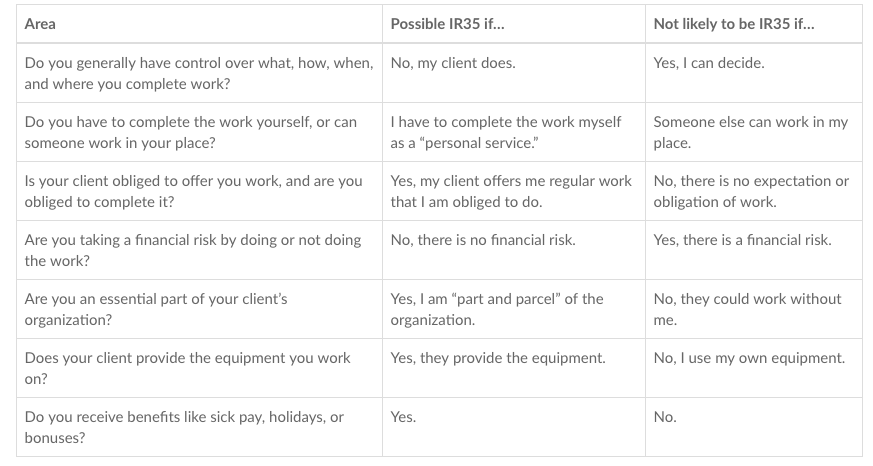
IR-35

An HMRC inspector will ask these and similar questions and use the balance of answers to decide if you would be affected by IR35. This will not be affected by how many contracts you have, the length of the contract, or any of the stated terms and conditions in the contract. HMRC inspectors can declare such contracts to be a “sham” and will decide on IR35 status independently of them. Instead, they will base their decision on your actual working relationship with your client.

The Government have devised this online tool(CEST) in which a series of questions are asked concerning the working practice of your contract, which will be used to determine your status.

What is the impact of being found liable under IR35?

If you are found liable under IR35, the main impact is that you will need to pay more tax. The amount will vary depending on your unique circumstances. HMRC will demand the difference in taxes and NI from you, including penalties and interest. HMRC can also go back up to six years and demand these payments retrospectively.

To find out more or if you have any questions , please contact your TR Consultant or visit the government website.


More Insights

Benjamin Hanrieder

Q&A Benjamin Hanrieder (CTO, Engel & Volkers)

In this interview, Benjamin Hanrieder, CTO at Engel & Völkers Technology, discusses the company’s digital transformation, software development practices, and the role of the Cloud Platform Team in ensuring reliable and secure infrastructure. Mat Roche (MR): Can you give us an overview of your background?  Benjamin Hanrieder (BH):  Hi Mat,

Read more >

Get In Touch

Fill out the form below, and we will be in touch shortly.

Seniority

Software Developers
Senior Engineers
Software Architects
Senior Software Architects
Software Tech Leads
Senior Software Tech Leads
Software Tech Lead Managers
Senior Software Tech Lead Managers
Director of Engineering
VP of Engineering


Software Developers
Senior Engineers
Software Architects
Senior Software Architects
Software Tech Leads
Senior Software Tech Leads
Software Tech Lead Managers
Senior Software Tech Lead Managers
Director of Engineering
VP of Engineering


Software Developers
Senior Engineers
Software Architects
Senior Software Architects
Software Tech Leads
Senior Software Tech Leads
Software Tech Lead Managers
Senior Software Tech Lead Managers
Director of Engineering
VP of Engineering


Role

Full-stack Developers
Back-end Developers
Front-end Developers
DevOps Engineers
SRE Engineers
Cloud Engineers
Platform Engineer
Security Engineers
Mobile Developers
App Developers
No1 software engineers

Full-stack Developers
Back-end Developers
Front-end Developers
DevOps Engineers
SRE Engineers
Cloud Engineers
Platform Engineer
Security Engineers
Mobile Developers
App Developers
No1 software engineers

Full-stack Developers
Back-end Developers
Front-end Developers
DevOps Engineers
SRE Engineers
Cloud Engineers
Platform Engineer
Security Engineers
Mobile Developers
App Developers
No1 software engineers

Skills

React.js
Node.js
AWS
JavaScript
React
Native
PostgreSQL
Ruby on Rails
Java
Angular
Golang
PHP

React.js
Node.js
AWS
JavaScript
React
Native
PostgreSQL
Ruby on Rails
Java
Angular
Golang
PHP

React.js
Node.js
AWS
JavaScript
React
Native
PostgreSQL
Ruby on Rails
Java
Angular
Golang
PHP

Sample By Job Family

Data Scientists
Data Engineers
Data Architects
Data Modelers
BI Developers
Data Analysts
Data Quality Engineers
Data Governance Experts MLOps Engineers
DataOps Engineers
Data Product Managers
Executive Data Leadership

Data Scientists
Data Engineers
Data Architects
Data Modelers
BI Developers
Data Analysts
Data Quality Engineers
Data Governance Experts MLOps Engineers
DataOps Engineers
Data Product Managers
Executive Data Leadership

Sample of Platforms & Tools

Cloud DW: Snowflake, BigQuery, Redshift ETL/ELT Tools: Airflow, dbt, Fivetran, Talend Big Data Frameworks: Spark, Hadoop, Kafka BI & Visualization: Tableau, Power BI, Looker ML Libraries: TensorFlow, PyTorch, Scikit MLOps Platforms: MLflow, Kubeflow, W&B Data Governance: Collibra, Alation Data Observability: Monte Carlo, Databand Data Lakes: Lake Formation, Delta Lake SQL/NoSQL DBs: PostgreSQL, MongoDB Real-time Analytics DBs: Apache Pinot, Druid Gen

Cloud DW: Snowflake, BigQuery, Redshift ETL/ELT Tools: Airflow, dbt, Fivetran, Talend Big Data Frameworks: Spark, Hadoop, Kafka BI & Visualization: Tableau, Power BI, Looker ML Libraries: TensorFlow, PyTorch, Scikit MLOps Platforms: MLflow, Kubeflow, W&B Data Governance: Collibra, Alation Data Observability: Monte Carlo, Databand Data Lakes: Lake Formation, Delta Lake SQL/NoSQL DBs: PostgreSQL, MongoDB Real-time Analytics DBs: Apache Pinot, Druid Gen

Sample of Skills Delivered

Programming in Python, R, and SQL
Python
Data Modeling Statistical
Analysis ETL/ELT
Pipeline Development
Database Design & Administration
Machine Learning Fundamentals
Cloud Data Warehousing
Data Ethics & Compliance
Data Security
Data Visualization & Storytelling
Real-Time Data Streaming

Programming in Python, R, and SQL
Python
Data Modeling Statistical
Analysis ETL/ELT
Pipeline Development
Database Design & Administration
Machine Learning Fundamentals
Cloud Data Warehousing
Data Ethics & Compliance
Data Security
Data Visualization & Storytelling
Real-Time Data Streaming

Sample By Job Family

AI Software Engineers
Gen AI Engineers
Machine Learning Engineers
Deep Learning Engineers
Prompt Engineers
AI Research Scientists
NLP Engineers
Computer Vision Engineers
MLOps Engineers
AI Product Managers
AI Governance Specialists
AI Ethics Office
AI Architects Executive

AI Software Engineers
Gen AI Engineers
Machine Learning Engineers
Deep Learning Engineers
Prompt Engineers
AI Research Scientists
NLP Engineers
Computer Vision Engineers
MLOps Engineers
AI Product Managers
AI Governance Specialists
AI Ethics Office
AI Architects Executive

Sample of Platforms & Tools

LLMs: Open AI, Anthropic, Llama, Gemini ML Platforms: SageMaker, Vertex AI, Azure ML ML Libraries: scikit-learn, XGBoost, LightGBM DL Frameworks: TensorFlow, PyTorch, Keras LLM Frameworks: LangChain, LlamaIndex Vector Databases: Pinecone, Weaviate, Milvus Data Science Notebooks: Jupyter, Colab, Kaggle Data Visualization Libraries: Matplotlib, Seaborn NLP Libraries: Hugging Face Transformers CV Libraries: OpenCV, Pillow, Albumentations MLOps Tools: MLflow, Kubeflow, W&B

LLMs: Open AI, Anthropic, Llama, Gemini ML Platforms: SageMaker, Vertex AI, Azure ML ML Libraries: scikit-learn, XGBoost, LightGBM DL Frameworks: TensorFlow, PyTorch, Keras LLM Frameworks: LangChain, LlamaIndex Vector Databases: Pinecone, Weaviate, Milvus Data Science Notebooks: Jupyter, Colab, Kaggle Data Visualization Libraries: Matplotlib, Seaborn NLP Libraries: Hugging Face Transformers CV Libraries: OpenCV, Pillow, Albumentations MLOps Tools: MLflow, Kubeflow, W&B

Sample of Skills Delivered

Generative AI Development
Machine Learning Algorithms
Deep Learning Architectures
NLP and NLG
Computer Vision
Data & Feature Engineering
MLOps & Model Deployment
Statistical Analysis & Hypothesis Testing
Python and R Programming Expertise
Model Evaluation & Performance Tuning
AI Governance & Compliance
Autonomous AI Agent Engineering
Building Agentic AI Applications

Generative AI Development
Machine Learning Algorithms
Deep Learning Architectures
NLP and NLG
Computer Vision
Data & Feature Engineering
MLOps & Model Deployment
Statistical Analysis & Hypothesis Testing
Python and R Programming Expertise
Model Evaluation & Performance Tuning
AI Governance & Compliance
Autonomous AI Agent Engineering
Building Agentic AI Applications
