
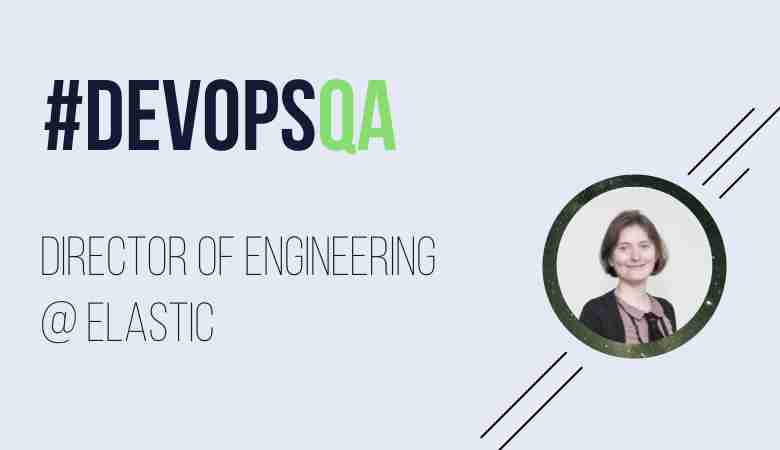
In our latest #DevOpsQA series, we sit down with Monica Sarbu, Director of Engineering at Elastic to talk all things tech and engineering.
Monica offers her advice to those managing distributed tech teams, the benefits and challenges that come with remote working and discusses the changes she is seeing in the industry in terms of diversity and women in tech.
Third Republic (TR): To kick-off could you explain a bit about your career journey and how you got into a career in tech?
Monica Sarbu (MS): As my parents were both engineers, I grew up surrounded by computers from an early age. I started with playing games like Prince of Persia. Then, being part of a computer science class in high school, I learned programming in Pascal and C. I even remember the vacation where I spent days and nights on my first graphical application written in Pascal. Then I decided to go to the computer science university that gave me a good start in my career in tech.
TR: What advice would you give to those starting out their careers in engineering?
MS: Computer science theory and fundamentals might seem boring compared to coding a website or an app, but it does prepare you for a long career. The technology landscape is changing every few years, so the most important skill is to understand the fundamentals that don’t change and be ready to learn new things. This doesn’t necessarily mean that you have to go to university, but you should spend time understanding the fundamentals of the field you get into.
If your situation allows, I would recommend taking more risks at the beginning of your career and work for a small company or startup. In a startup, each engineer is responsible for a larger project than in a big company where each team has a specialised role. This means that in a startup you can get a broader experience. Being in tech, especially in startups, can be quite stressful, so it’s important to work on things that you genuinely enjoy and motivate you.
Finally, always be kind and humble! Software engineering requires a surprising amount of soft skills. The people that have good communication skills, that know how to listen and have empathy for their colleagues tend to have a better and more enjoyable career.
TR: What are some of the benefits and challenges of a career in tech and/or engineering?
MS: A career in tech can bring you a lot of satisfaction. Software is changing the world and it’s up to us to make sure it’s changing it for the better. The tech landscape is changing all the time, and that means you won’t get bored into repetitive tasks. You will enjoy endless company perks and you’ll feel spoiled most of the time.
You will meet a lot of smart and kind people. You will also meet a few unkind people. Try not to let them define your career. If you find yourself in a toxic environment that you don’t have the power to challenge or change, find another company. I promise you there are better places. It sometimes takes courage to change jobs, but it’s usually worth it.
TR: Could you give some of your top tips on how to effectively manage distributed teams?
MS: Trust your team members. This is important in any team but especially in a geographically distributed one. Show people that you trust them to organise their schedule and prioritise their work. Rather than tracking their every move, look at their productivity and results over a longer period of time (e.g. 3 months).
Hire more seniors. In a distributed team you typically want to have more senior engineers, who are used to driving projects independently and are efficient in communication. You can, and should, be mentoring juniors as well but be careful when adding too many junior engineers at the same time. Ensure you have the capacity to dedicate time and recourses to those new to the industry. When hiring, optimise and test for good communication skills, these are even more important in a distributed team than in a co-located team.
Favour async communication. Being distributed will force you to adopt more asynchronous means of communication (email, GitHub issues). This is a feature because it means you automatically document decisions and thought processes. This is generally more inclusive and future team members are going to be grateful. Be wary of chat services such as Slack. Decisions and conversations can easily get lost in them, and you’ll be missing the benefits of written communication.
Regular team meetings. Make sure your team is meeting at least once or twice per week on video. This gives the team time to brainstorm and explore ideas that would be otherwise hard to bring up over email. Try to meet as often as possible face-to-face, where the team gathers in the same physical location and spends time together.
TR: What are some of the benefits and challenges of your team working remotely?
MS: There’s a lot of benefits. For the company, it’s much easier to find talent when you are not bound to a physical location. Finding great people is currently one of the biggest bottlenecks for companies everywhere. There are a lot of great engineers that don’t like living in a hub or simply prefer working from home. The company can still provide offices in a few large cities for the engineers that prefer coming to an office. As long as everyone is having a distributed mindset, offices are not bad, they provide more options for the employees.
For the employees, it means they can build up their own schedule, they save time from not having to commute, they can spend more time with their families or hobbies, and they have more autonomy. If they miss socialising at work or just getting out of the house, they can visit one of the offices or go to a co-working space. The employees can choose to live and work in the country or state that they like, rather than the one where they can find interesting work. It’s now their choice and that makes them feel free.
There are challenges as well. If the team spreads over multiple continents, time-zones become a serious problem. For example, if you have people in San Francisco and Berlin, there is very little “business hours” overlap, so it’s hard to find meeting times. It’s important for everyone in Europe to have empathy for the people in the US that wake up very early to speak with them and the other way around.
Another challenge for the employees is that with the flexible hours it’s sometimes hard to know when to stop working. When there’s enthusiasm in the team, people tend to work long hours but it’s the manager’s responsibility to make sure everyone is pacing themselves and not approaching burnout. As a manager, encourage people to block their calendars for family time, dinner, and other life events.
TR: Since your career in tech began, have you seen any changes to the industry in terms of diversity, particularly with women in tech?
MS: We are making progress against stereotypes and biases and there’s more awareness now, but it’s going slow. When I started 13-14 years ago, there was very little awareness of the unconscious biases that women in tech have to fight daily. Today, there are more and more people that understand it’s an issue and are making efforts to improve and give women more chances.
But we still have a long way to go. Quite often, a woman has to work twice as hard and be twice as knowledgeable as a man in order to be recognised the same. Unfortunately, this means that a lot of women are pushed away and give up their careers, which in turn reinforces the stereotypes.
Today, there are leaders that understand that diversity and inclusion is their responsibility and take real steps in improving the diversity of their teams. But there are also a lot of leaders that pay lip service to diversity and inclusion but do nothing concrete about it.
TR: What do you think businesses can do to ensure that their tech teams are becoming more diverse?
MS: If you want to attract more diverse candidates, you need to put in a bit of effort. Here are some tips: Make sure the job description is gender neutral and doesn’t use off-putting words like “rock star”, “10x developer” or “ninja”. Also, make sure you have at least one woman in the interview process. If you have all-men teams, make it clear to the team lead or manager that that is a problem and they need to improve. Collect feedback about the interview process from the women that you reject or that don’t choose your company. Pay special attention to the exit interviews for any woman that leaves the team.
Allow a flexible schedule that allows women to find the right work-life balance without the need to sacrifice one or another. Support them and encourage them to grow in their career. Whenever you organise a keynote or a company all-hands, make sure your presenters are diverse. Create a mentorship program for women where you engage women from different levels of the company.
I don’t think any of the above is hard, and it makes the difference between just claiming you care about diversity and actually taking steps in the right direction.
TR: Finally, how do you think businesses can best attract top technical talent?
MS: In my experience, top engineers are looking for autonomy, for a diverse and pleasant work environment, for a healthy work-life balance, and a mission that they can associate with. They want to be recognised and compensated according to their contributions. They don’t care about things like ping-pong tables and catered lunches, they can get that anywhere, so don’t lead with that sort of thing in your job posts.
Being a fully distributed company and allowing engineers to work from wherever they are is a great way to attract top talent. If you can do that in your company, I recommend taking advantage of it.
If you’re interested in taking part in our next Tech Q&A, or are looking to source tech talent get in touch with our specialist teams today!


