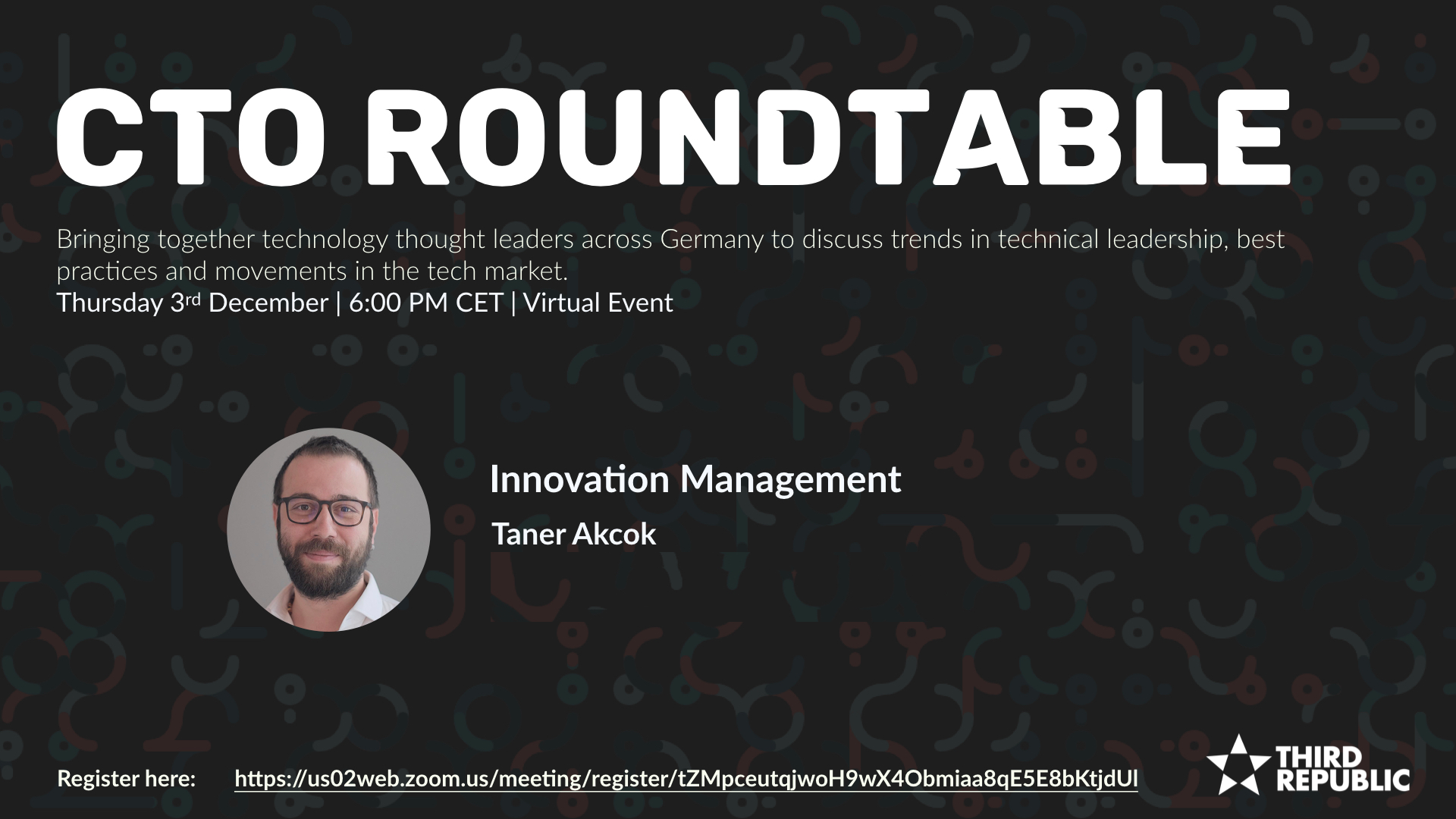
CTO Roundtable – Innovation Management

In December we held the final CTO Roundtable event of 2020. In what was a very challenging year for most people, both on a personal and professional level, it was great to finish strong and get so many technology thought leaders from Berlin around the virtual table to discuss the topic of ‘innovation’.

In a year that forced so many businesses to adapt so dramatically to ensure survival, from their operating models to their infrastructure and working practices, it seemed like an obvious topic to dissect, discuss best practice and key learnings to take into 2021.

The discussion was led by Taner Akcok.

History of Innovation

Taner began the discussion by quoting George Orwell; ‘those who control the past control the future, those who control the present control the past.’ This is an interesting starting point when discussing innovation as it is important to reflect on the history of the industrial revolution; from industry 1.0 (Production), to 2.0 (Product), 3.0 (Sales & Marketing) and finally 4.0 (Innovation). In this industry we have unlimited supply and demand. Big brands are producing on an exponential scale and the demand is similarly limitless. A great example of this is the latest version of a new smart phone, although not hugely different from the previous version the demand is still so high.

When discussing innovation, Taner emphasises the need to differentiate between innovation and invention. Innovation is a new idea or invention plus monetization. If there is not monetization there is no innovation. If you cannot monetize a great feature or product then it is not innovation.

Every product dies. That is the destination for all products and technologies. Managing innovation is crucial for postponing the ‘dog’ phase of the product. This drives us to the question; is innovation manageable or not?

Two Types of Innovation

There are two types of innovation: evolutionary and revolutionary. An example of evolutionary innovation is the new iPhone or IBM devices, in contrast an example of a revolutionary innovation is the lightbulb. To be able to drive innovation you need to have the right people in your organisation.

Innovation Management

Managing innovation is like flipping a coin. When you flip a coin a lot of people think there is a 50/50 chance of head or tails. But if you can calculate variables such as flipping speed, gravity and air resistance you are able to calculate if it will be heads or tails; there is no probability. This is the same for product management. If you can consider all the variables in the market: new technologies, trends, market research, competitor analysis, there is no probability for innovation.

Of course, we can not know everything and there are sometimes variables that cannot be quantified or analysed. In this case it is helpful to have a framework which can give you some information that will bring you closer to taking the leap of faith.

The innovation engine of a business collects market research, new technologies & trends, competitor intelligence and customer feedback to be able to create value added information – user stories – in order to inform engineers what they are supposed to build. Engineers collect these user stories and requirement to design future proof architecture, software and system.

For the engineering side of a business innovation is driven by cost and return of investment on the technology. The engineering team creates value added product or service that customers can use. This is where product management joins and checks KPI’s, performance monitoring, and if the product performs as desired they keep the product but if there are problems they begin to create hypotheses to determine the issue; i.e. lack of user experience of lack of design.

The talk was followed by an interesting Q&A session with a number of insightful points; both by those who agreed and disagreed with Taner’s systematic innovation framework.

Thank You

We’d like to thank Taner and all the attendees for making the event such a success. We are already in the process of planning the next one!

If you are interested in speaking at, or attending, our next event don’t hesitate to contact Third Republic or even the host Richard Atkinson directly

More Insights

Benjamin Hanrieder

Q&A Benjamin Hanrieder (CTO, Engel & Volkers)

In this interview, Benjamin Hanrieder, CTO at Engel & Völkers Technology, discusses the company’s digital transformation, software development practices, and the role of the Cloud Platform Team in ensuring reliable and secure infrastructure. Mat Roche (MR): Can you give us an overview of your background?  Benjamin Hanrieder (BH):  Hi Mat,

Read more >

Get In Touch

Fill out the form below, and we will be in touch shortly.

Seniority

Software Developers
Senior Engineers
Software Architects
Senior Software Architects
Software Tech Leads
Senior Software Tech Leads
Software Tech Lead Managers
Senior Software Tech Lead Managers
Director of Engineering
VP of Engineering


Software Developers
Senior Engineers
Software Architects
Senior Software Architects
Software Tech Leads
Senior Software Tech Leads
Software Tech Lead Managers
Senior Software Tech Lead Managers
Director of Engineering
VP of Engineering


Software Developers
Senior Engineers
Software Architects
Senior Software Architects
Software Tech Leads
Senior Software Tech Leads
Software Tech Lead Managers
Senior Software Tech Lead Managers
Director of Engineering
VP of Engineering


Role

Full-stack Developers
Back-end Developers
Front-end Developers
DevOps Engineers
SRE Engineers
Cloud Engineers
Platform Engineer
Security Engineers
Mobile Developers
App Developers
No1 software engineers

Full-stack Developers
Back-end Developers
Front-end Developers
DevOps Engineers
SRE Engineers
Cloud Engineers
Platform Engineer
Security Engineers
Mobile Developers
App Developers
No1 software engineers

Full-stack Developers
Back-end Developers
Front-end Developers
DevOps Engineers
SRE Engineers
Cloud Engineers
Platform Engineer
Security Engineers
Mobile Developers
App Developers
No1 software engineers

Skills

React.js
Node.js
AWS
JavaScript
React
Native
PostgreSQL
Ruby on Rails
Java
Angular
Golang
PHP

React.js
Node.js
AWS
JavaScript
React
Native
PostgreSQL
Ruby on Rails
Java
Angular
Golang
PHP

React.js
Node.js
AWS
JavaScript
React
Native
PostgreSQL
Ruby on Rails
Java
Angular
Golang
PHP

Sample By Job Family

Data Scientists
Data Engineers
Data Architects
Data Modelers
BI Developers
Data Analysts
Data Quality Engineers
Data Governance Experts MLOps Engineers
DataOps Engineers
Data Product Managers
Executive Data Leadership

Data Scientists
Data Engineers
Data Architects
Data Modelers
BI Developers
Data Analysts
Data Quality Engineers
Data Governance Experts MLOps Engineers
DataOps Engineers
Data Product Managers
Executive Data Leadership

Sample of Platforms & Tools

Cloud DW: Snowflake, BigQuery, Redshift ETL/ELT Tools: Airflow, dbt, Fivetran, Talend Big Data Frameworks: Spark, Hadoop, Kafka BI & Visualization: Tableau, Power BI, Looker ML Libraries: TensorFlow, PyTorch, Scikit MLOps Platforms: MLflow, Kubeflow, W&B Data Governance: Collibra, Alation Data Observability: Monte Carlo, Databand Data Lakes: Lake Formation, Delta Lake SQL/NoSQL DBs: PostgreSQL, MongoDB Real-time Analytics DBs: Apache Pinot, Druid Gen

Cloud DW: Snowflake, BigQuery, Redshift ETL/ELT Tools: Airflow, dbt, Fivetran, Talend Big Data Frameworks: Spark, Hadoop, Kafka BI & Visualization: Tableau, Power BI, Looker ML Libraries: TensorFlow, PyTorch, Scikit MLOps Platforms: MLflow, Kubeflow, W&B Data Governance: Collibra, Alation Data Observability: Monte Carlo, Databand Data Lakes: Lake Formation, Delta Lake SQL/NoSQL DBs: PostgreSQL, MongoDB Real-time Analytics DBs: Apache Pinot, Druid Gen

Sample of Skills Delivered

Programming in Python, R, and SQL
Python
Data Modeling Statistical
Analysis ETL/ELT
Pipeline Development
Database Design & Administration
Machine Learning Fundamentals
Cloud Data Warehousing
Data Ethics & Compliance
Data Security
Data Visualization & Storytelling
Real-Time Data Streaming

Programming in Python, R, and SQL
Python
Data Modeling Statistical
Analysis ETL/ELT
Pipeline Development
Database Design & Administration
Machine Learning Fundamentals
Cloud Data Warehousing
Data Ethics & Compliance
Data Security
Data Visualization & Storytelling
Real-Time Data Streaming

Sample By Job Family

AI Software Engineers
Gen AI Engineers
Machine Learning Engineers
Deep Learning Engineers
Prompt Engineers
AI Research Scientists
NLP Engineers
Computer Vision Engineers
MLOps Engineers
AI Product Managers
AI Governance Specialists
AI Ethics Office
AI Architects Executive

AI Software Engineers
Gen AI Engineers
Machine Learning Engineers
Deep Learning Engineers
Prompt Engineers
AI Research Scientists
NLP Engineers
Computer Vision Engineers
MLOps Engineers
AI Product Managers
AI Governance Specialists
AI Ethics Office
AI Architects Executive

Sample of Platforms & Tools

LLMs: Open AI, Anthropic, Llama, Gemini ML Platforms: SageMaker, Vertex AI, Azure ML ML Libraries: scikit-learn, XGBoost, LightGBM DL Frameworks: TensorFlow, PyTorch, Keras LLM Frameworks: LangChain, LlamaIndex Vector Databases: Pinecone, Weaviate, Milvus Data Science Notebooks: Jupyter, Colab, Kaggle Data Visualization Libraries: Matplotlib, Seaborn NLP Libraries: Hugging Face Transformers CV Libraries: OpenCV, Pillow, Albumentations MLOps Tools: MLflow, Kubeflow, W&B

LLMs: Open AI, Anthropic, Llama, Gemini ML Platforms: SageMaker, Vertex AI, Azure ML ML Libraries: scikit-learn, XGBoost, LightGBM DL Frameworks: TensorFlow, PyTorch, Keras LLM Frameworks: LangChain, LlamaIndex Vector Databases: Pinecone, Weaviate, Milvus Data Science Notebooks: Jupyter, Colab, Kaggle Data Visualization Libraries: Matplotlib, Seaborn NLP Libraries: Hugging Face Transformers CV Libraries: OpenCV, Pillow, Albumentations MLOps Tools: MLflow, Kubeflow, W&B

Sample of Skills Delivered

Generative AI Development
Machine Learning Algorithms
Deep Learning Architectures
NLP and NLG
Computer Vision
Data & Feature Engineering
MLOps & Model Deployment
Statistical Analysis & Hypothesis Testing
Python and R Programming Expertise
Model Evaluation & Performance Tuning
AI Governance & Compliance
Autonomous AI Agent Engineering
Building Agentic AI Applications

Generative AI Development
Machine Learning Algorithms
Deep Learning Architectures
NLP and NLG
Computer Vision
Data & Feature Engineering
MLOps & Model Deployment
Statistical Analysis & Hypothesis Testing
Python and R Programming Expertise
Model Evaluation & Performance Tuning
AI Governance & Compliance
Autonomous AI Agent Engineering
Building Agentic AI Applications

