
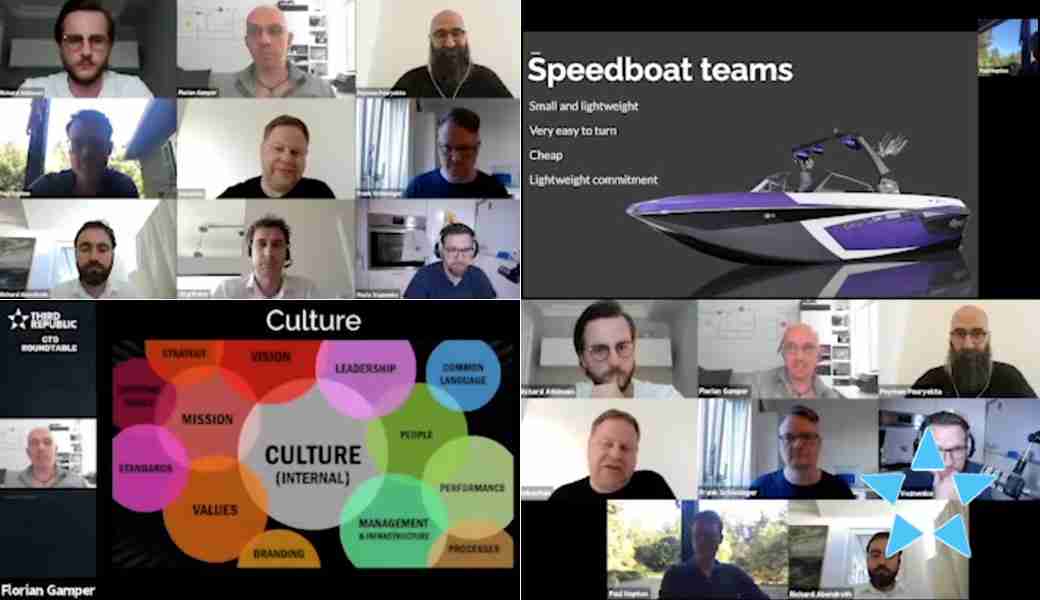
At the end of July 2020, we hosted our first CTO roundtable event, bringing together technology thought leaders to discuss important and relevant topics in the industry. The event was a great success, with many insights and collaborations between attendees.
A lot has been written over the last few months on remote working and how companies need to adapt to this ‘new’ way of working. I have long been an advocate for more flexible working arrangements so a lot of the discussion around this topic has not been new to me. Whilst it is true that the COVID-19 outbreak has forced the hand of most (if not all) companies, I do believe that this level of remote working was always going to be the destination, recent events have just made us arrive a lot sooner than we expected. This has created a new set of challenges for businesses, none more so than the problem of maintaining/growing company culture.
I wanted to bring together thought leaders in the industry to discuss how they are combatting this challenge, and the measures they are putting in place to ensure the culture of their Engineering teams are maintained.
Challenges of Working in a Remote Environment
Peyman Pouryekta, CTO at Spectrm kicked-off the evening by describing how his company is attempting to maintain the social culture they have built, whilst remote working. Providing a background into his career in tech, Peyman explained that this was not the first point in his career that he has worked remotely. Whilst in his first role in the industry, working in a team of four, the position was completely remote. The team would regularly hold meetings in an informal setting; having breakfast, to sustain a level of social culture within the organisation. The main benefits of working in this remote environment were the flexibility it provides, as well as a focus of orientation towards projects, making it clear what needed to be completed during particular time periods, generating a lack of dependency on other individuals within the team. Work-life balance proved difficult to maintain.
In his current company, it was noted that a main problem was the lack of preparation for remote working, however, the achievability of a completely remote company was later realised. Difference in culture when remote working for individuals; some people need more interaction that others. Organised crossfit yoga sessions, delivered home packages to employees to generate an understanding of ‘togetherness’ within the organisation. Due to the ease that the company transitioned to remote working, they had to consider whether to go remote full-time like other organisations. Market research within the company showed that a hybrid of home and office working was the most appropriate course of action. Clear boundaries are set to accomplish this; although you have increased flexibility, must be available for work calls, i.e consider time differences. Organisation of the office is important, creation of a ‘seat-booking’ system for employees that want to work in the office.
Below are the highlights from the following networking discussion, attendees agreed that their experiences of working in a report environment were similar, and that they considered the same issues:
- Remote conversation level is decreasing – loss of contact
- Use of daily meetings, ‘coffee breaks’ to have conversations with people
- Casual team meetings and events after work to not lose touch are needed
- Hybrid approach of home and office working is important in the beginning of a transition to completely remote working
- Use of online games
- Variation in events is essential to not lose the engagement of employees
- Biggest challenge is the difficulty in recreating the organic spontineity of conversations when remote working
- Lack of transparency in communication – to prevent this initiate communication in public spaces – Slack channels
Things to Remember When Moving to a Remote Culture
The second speaker of the event was Florian Gamper, Freelancer Interim CTO and Agile Evangelist. Three company types: non-remote, partially remote and remote first. Non-remote do not miss the organic social interaction because they haven’t experienced it. Current transformation from non-remote to remote first and back. Florian noted a misconception about remote first companies, people think that they don’t have an office but they do. First and foremost there needs to be a mindshift in the way in which companies view remote work. Culture is connected to so many variables that it is difficult to quantify. Culture in a business relates to management and infrastructure, the people, leadership, vision, values, strategy etc.
Florian spoke about how to maintain this culture when transforming to a remote first company. A lot about communication, which in every company is different. Two types of communication; formal and informal. Formal communication passes through predefined channels throughout the organization and is therefore rather easy to replicate through Video meetings, internal Wiki etc. However, in a business of 5-50 people 85% of interactions in the office are informal, on average. This is what is most difficult to recreate as it is a form of communication that flows in every direction and moves freely in the business; chat in the hall, over the coffee machine etc.
One of the ways in which to maintain culture through formal communication is by ‘formalising information’. You need an information strategy; where will we store things, how do we use chats? Basically all business processes need to transform to online. You can create communication flows that increase accountability, traceability and create protocols that foster communication. This is particularly prominent for remote working otherwise information is lost easily. This is generally already best practice amongst a lot of tech/software engineering teams who work with tools such as Jira that enable them to raise tickets and track progress and rate the urgency or various tasks.However, it can take time for employees to get used to these new methods. One way in which you can manage how the culture is maintained in these communications, and ensure information is passed on effectively, is by limiting the number of people on video conferences to make them more interactive.
What a lot of people focus on when working remotely is the infrastructure, tools such as trello, slack, Microsoft teams, Flock, and don’t pay enough attention to the management or the reporting. Whilst these tools are helpful for communicating and acute problems, they are often overused and dilute useful information. Creating an ‘information nightmare’. People can step away from their desk for an hour and come back to 4 or 5 slack channels going off each with 50 messages. There is no way for busy professionals to consume all the information in there. This leaves an accountability vacuum as employees think that by writing something in slack they have passed accountability from themselves to the recipient.
The biggest challenge for culture when working remotely is how to foster informality. Some ways you can do this daily are; morning coffee, lunch meeting, evening where you catch up for 10 minutes but do not discuss work, this can give the day structure for employees. Monthly team events. Game nights etc. An important aspect of initially moving to a remote environment is over communication.
In order to decrease video meeting fatigue, Florian notes that one solution is to change the time of meetings from one hour to 50 minutes, so that people can take breaks between their meetings and get a change of scenery, like they would in an office environment. Also having no more than 4 video meeting calls a day, in order to sustain information intake.
During the networking session after Florian’s presentation it was agreed that processes need to be more formalised when working remotely, to not miss important information. There is a need to identify the appropriate media for the right information and communication. Chat flows are usually often temporary, a more lasting method of communication is better utilised for different types of information, for example, only using Slack for direct communication, outcomes go into ‘tickets’.
Engineering Speedboats
The final speaker of the evening’s event was Paul Hopton, previous CTO at reylar. Paul proposed an initiative that he introduced into the team during his time called, ‘Engineering Speedboats’. The initiative was used to overcome a sense of weariness and tiredness within the organisation. In order to create higher levels of engagement and greater sense of purpose it may be useful to build ‘speedboat’ teams. Bringing creativity, innovation and enthusiasm back to the organisation. Why a speedboat? They are small and lightweight, very easy to turn, cheap and a lightweight commitment. They only need a few people involved, otherwise everyone would fall out of the speedboat. These teams are also able to take more risks, as they are not leading the whole organisation. A lot of companies are designed like huge oil tankers that will struggle to adapt to new ways of remote working. These teams are difficult to turn, slow moving, expensive to operate and change. They lose sight of the user, have an obsession with infrastructure, stale product roadmaps. This leads to a drop in motivation, drop in velocity, increase in errors, increase in churn and an increase in conflict due to inertia.
The greatest number of people to have in a speedboat is three: Product Owner, Frontend Engineer and a Designer. Moving everybody else into the background leads to faster inferations across software. The bulk of the team still works on the infrastructure features, but the speedboat team produces things in a tight turnaround. Allows for the solving of problems as they occur with these teams.
Important to have a trial period with employees, so they can assess whether they want to work in a speedboat, or not, one quarter is recommended. Helps transition. Results from this initiative include: high levels of engagement, greater sense of purpose, improved relations as well as improvements in non-speedboat outputs.
In the final networking session of the event, attendees shared their similar experiences and different methods used to reduce this lack of motivation and output. Team sizes are essential to this outcome. Reduction of teams from 10-15 to 4-5 people. This avoids having ‘to many chiefs in the kitchen’. The benefit of reducing team sizes is the decrease in communication between people in the organisation which results in things getting completed quicker. Need to encourage a culture of ‘customers’ within the organisation; teams view other teams as internal customers. Market segments within the organisation can increase competition between teams. Life-cycle of the team needs to be short and is a huge challenge as people do not think about teams ending.
Thank You
Our first roundtable event was a great success and we’re already in the process of planning number two! I’d like to thank everyone who attended, and the fantastic speakers for contributing to such an insightful and fun evening.
If you’re interested in speaking at our next event or even attending one, please don’t hesitate to contact Third Republic or even the host Richard Atkinson directly.


