
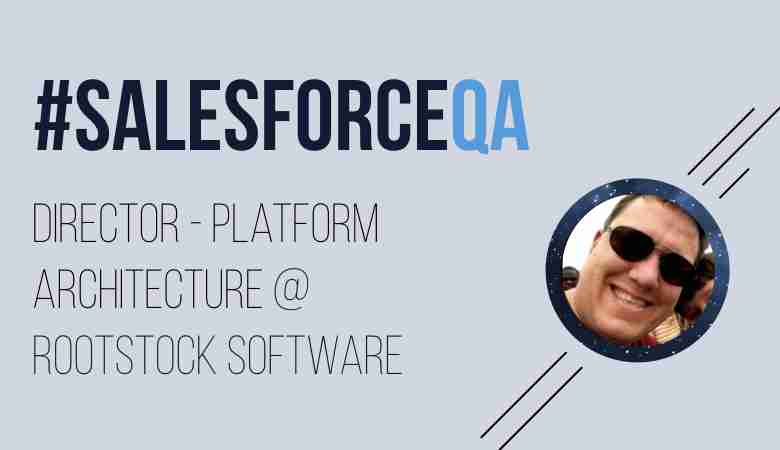
In our most recent Salesforce Q&A interview, we caught up with Director, Platform Architecture at Rootstock Software, John Daniel.
John talks to us about how Salesforce has changed during throughout the last 10 years since he started working with the software. Reveals the best advice that he’s received throughout his career in Salesforce. And discusses the emerging trend that he is most excited about and why.
Third Republic (TR): How did you begin your career in Salesforce? How did you get to where you are today?
John Daniel (JD): I have been in IT development and architecture for over 25 years; mostly in Java/J2EE type projects. Around 10 years ago, a friend told me about an opportunity with a local start-up company. They were looking for someone to carry out development work and asked if I would be willing to come on board.
Since then I have been able to take advantage of talking with all sorts of people and other developers in the community. The Salesforce Community has been very willing to share their experiences and talk through ideas. Also, working towards the various Salesforce certifications helped me to research and learn the various aspects of what Salesforce is and what it can do.
TR: How has the Salesforce world changed during your time in it?
JD: The Salesforce world has grown a lot in the past 10 years. The certification program has matured tremendously and expanded in that time. The availability of resources to learn the platform has also been one of the key accelerators to the community’s growth. From the advent of Trailhead Learning System to the various Trailblazer communities to the local user groups, there are so many opportunities and ways to learn about Salesforce now.
The technology has transformed quite a bit during the time as well. The invention of SalesforceDX, Lightning Component Framework, and Platform Events/Change Data Capture represent some key “game-changers” in how development is handled in Salesforce and what the platform can scale to in order to meet the demands of today’s enterprise market.
TR: What do you enjoy most about working within the Salesforce ecosystem?
JD: The Salesforce ecosystem is always changing and improving. There is always something new coming out and always something new to learn.
I also enjoy watching others learn about the platform. The “barrier to entry” to learn about the platform is very low compared to other technologies. Thus a large number of people are finding it a good time to enter the Salesforce Community.
TR: What are the biggest challenges you have faced throughout your career and how did you overcome these?
JD: Getting started was the biggest challenge. There is so much to learn and see in the Salesforce Platform that it can be overwhelming. In some respects, it was actually easier for me because I already had 15+ years of a technology background to draw from. But I still found it challenging.
Like everything in life, perseverance and patience will be two of the biggest things that will help you overcome the challenges that come with a career in the Salesforce ecosystem.
TR: What is the best advice you’ve been given that has helped you on your Salesforce journey?
JD: “Get involved in the community”. This was the advice that I was given when I was at Mavens Consulting 9 years ago. We were at a company all-hands meeting in Las Vegas and there was a talk about engaging in the Salesforce Community. “Join the Trailblazer groups”, “join the local user groups”, and even “get a Twitter handle” were things that we heard that day.
I had never been a big fan of social media prior to that talk but afterwards, I got on Twitter (@ImJohnMDaniel), looked for people that I had heard talk at Dreamforce and TrailheaDX, or written books and started watching their conversations with others in the community. Over the years, I have learned who the thought leaders are in the community, read their books and blogs and watched their talks. I even engaged with them and have formed numerous friendships over time. These associations have helped me the most through my Salesforce journey.
TR: How important do you think the Trailblazer community is to achieving success in the ecosystem?
JD: I believe that the Trailblazer community is vital to success in Salesforce. I learned a long time ago that nothing I build or develop is anything new. Chances are someone, somewhere has done the same thing or has run into an issue that I am currently facing. Engaging in the community allows me to find solutions that might have worked for others and I can learn from their mistakes.
TR: Do you think Salesforce certifications are a good way to continue career development?
JD: Salesforce certifications are an excellent way to learn. I see that there are two ways that they help. First, with all of the support material that the Salesforce Certification Team has organized around attaining certifications, they allow you to focus on a specific area and study it in its totality.
Second, the various certification tracks expose you to parts of the platform that you would not normally deal with in your day-to-day life. For example, any code developers that I mentor, I advise them to get the Platform Developer 1 and 2 certifications. But I also recommend the Salesforce Administrator and Advanced Administer certifications.
The reason is the Salesforce Platform has a great many things to offer. Each of the technologies have their strengths and weaknesses and specific times when it’s appropriate to use them. If you are a developer, but don’t study “user management”, “profiles and permission sets”, and “role hierarchies”. You could easily miss some of the strongest features of the platform and waste time trying to “reinvent the wheel.” I know I made that mistake once.
TR: What emerging trends are you most excited about, and why?
JD: Two of the most powerful trends that are emerging in the world of Salesforce are 1) Platform Events/Change Data Capture and 2) Second Generation Packaging
Platform Events represents Salesforce’s answer to the technology concept of “async messaging”. It is a powerful concept that other technologies have been taking advantage of for years now. This allows us to design applications and processes on the Salesforce Platform that can scale to a much larger degree than has been possible before.
Second Generation Packaging will shift the way we organize our code and how we manage that logic through the development lifecycle. No longer do we view the Salesforce org as a collection of metadata in a preverbal “happy soup”. Now we can start organizing our code into modules. Modules that can be reused and logically separated. This is a deceptively simple description that has an immense impact in the world of enterprise architecture. We can better audit and migrate our logic from one stage to the next. We will be able to finally start taking advantage of some basic concepts that other technologies have been able to use for years.
In the coming years, two trends will radically reshape how we think about Salesforce in the enterprise ecosystem.
TR: Finally, do you have any further comments or advice for those new to navigating the ever-changing world of Salesforce?
JD: Find someone in the community that you can learn from. Join a user group, and become active on Trailblazer Community. And, if you’re not already, get on Twitter!
If you’re a Salesforce professional and would like to be involved in our Q&A series, please get in touch with us today!


