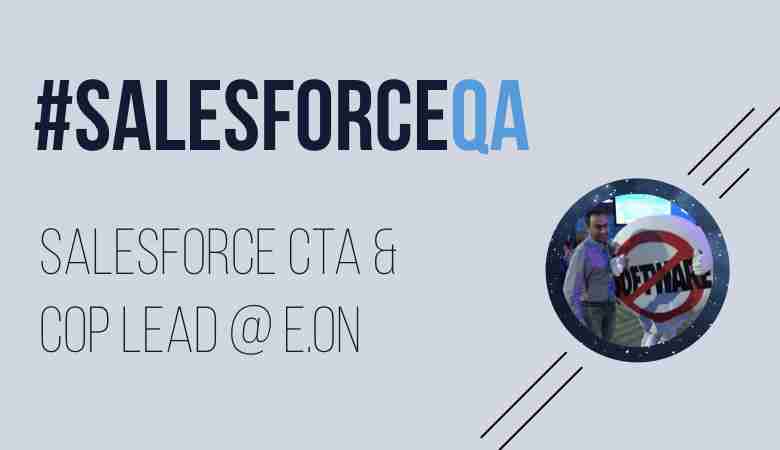
#SalesforceQA – Ali Najefi, Salesforce CTA

In our most recent #SalesforceQA, we caught up with Salesforce Certified Technical Architect and COP Lead at E.ON Ali Najefi. Ali reveals his top 5 tips for others looking to become a Salesforce CTA, the key traits that are needed for success as a CTA and discusses his predictions for the future of Salesforce.

Third Republic (SR): Could you talk us through your career, how you got into the Salesforce ecosystem and how you got to where you are today?

Ali Najefi (AN): Back in 2008 / 2009, I started my search looking for a new technology platform and got to know Salesforce. At the time, I was working as a product developer at Sage, but I was keen to learn something new and luckily found Salesforce.

I left Sage for a Salesforce developer role in 2010 and ever since have been working in the Salesforce ecosystem.

TR: What are some of the benefits and challenges of becoming an Architect in the Salesforce ecosystem?

AN: Salesforce has grown exponentially over the past decade and has numerous enterprise customers across the world, and this will bring the advantages of working on large Salesforce implementation projects which everyone can learn from.

The challenges for an architect when working on an enterprise project would be to dealing with other platforms outside Salesforce for some.

TR: What are your 5 top tips for others looking to start their career in the Salesforce ecosystem? 

AN: These are my top 5 tips for others: 

1. Start with small projects
2. Hands-on experience before certification
3. Learn Salesforce by working on different projects and don’t rush your way up the
ladder
4. Learn the configuration and all the platform features thoroughly before coding
5. Don’t focus only on one Salesforce product but rather the whole Salesforce
ecosystem

TR: In your experience, what are some of the key traits that you need in order to succeed as a Salesforce Certified Technical Architect?

AN: Experience is the key, and you can gain it by working on projects at different scales. A CTA should:

  • Know Salesforce products not all but most to a very good extent i.e. limitations, features, etc.
  • Have worked on multiple large-scale Salesforce projects from solution architecture and design perspective
  • Have enterprise-level architecture expertise.
  • Have worked as a developer.

TR: What are some of the different routes people can take to start their journey to becoming a Salesforce CTA?

AN: I see only one route, and that is gaining the experience you need before you start your journey.

TR: What advice do you have for those starting their Technical Architect Certification?

AN: Don’t rush into this! First and foremost, try getting enough experience that this certification requires. For me, a CTA requires a minimum of 10 year’s experience in Salesforce before he or she can plan the journey for this cert.

TR: Could you talk about your views on certifications as a whole? Do you think they are essential for success?

AN: I would say the certifications would give you a basic knowledge, but I don’t see them as a critical factor to pass the CTA.

TR: In your opinion, how important is the Salesforce community when it comes to career advancement?

AN: I believe one of the reasons Salesforce has been very successful is because of the Salesforce community, and this certainly helps everyone in advancing their career as well.

TR: Finally, what are your predictions for the future of Salesforce?

AN: I believe Salesforce will continue to grow for one big reason and that is the CEO and founder, Marc Benioff, he is a great visionary. He sees the future well ahead of others, and that has always helped Salesforce to be one of the most innovative product companies in the world.

The excellent example of that is how Salesforce dealt with COVID-19. Salesforce came up with a whole new product called work.com in such a short time-scale which was purchased by the governments and companies across the world. 


If you’re a Salesforce professional and would like to join Ali Najefi, in our Q&A series, please get in touch with us today!


More Insights

Benjamin Hanrieder

Q&A Benjamin Hanrieder (CTO, Engel & Volkers)

In this interview, Benjamin Hanrieder, CTO at Engel & Völkers Technology, discusses the company’s digital transformation, software development practices, and the role of the Cloud Platform Team in ensuring reliable and secure infrastructure. Mat Roche (MR): Can you give us an overview of your background?  Benjamin Hanrieder (BH):  Hi Mat,

Read more >

Get In Touch

Fill out the form below, and we will be in touch shortly.

Seniority

Software Developers
Senior Engineers
Software Architects
Senior Software Architects
Software Tech Leads
Senior Software Tech Leads
Software Tech Lead Managers
Senior Software Tech Lead Managers
Director of Engineering
VP of Engineering


Software Developers
Senior Engineers
Software Architects
Senior Software Architects
Software Tech Leads
Senior Software Tech Leads
Software Tech Lead Managers
Senior Software Tech Lead Managers
Director of Engineering
VP of Engineering


Software Developers
Senior Engineers
Software Architects
Senior Software Architects
Software Tech Leads
Senior Software Tech Leads
Software Tech Lead Managers
Senior Software Tech Lead Managers
Director of Engineering
VP of Engineering


Role

Full-stack Developers
Back-end Developers
Front-end Developers
DevOps Engineers
SRE Engineers
Cloud Engineers
Platform Engineer
Security Engineers
Mobile Developers
App Developers
No1 software engineers

Full-stack Developers
Back-end Developers
Front-end Developers
DevOps Engineers
SRE Engineers
Cloud Engineers
Platform Engineer
Security Engineers
Mobile Developers
App Developers
No1 software engineers

Full-stack Developers
Back-end Developers
Front-end Developers
DevOps Engineers
SRE Engineers
Cloud Engineers
Platform Engineer
Security Engineers
Mobile Developers
App Developers
No1 software engineers

Skills

React.js
Node.js
AWS
JavaScript
React
Native
PostgreSQL
Ruby on Rails
Java
Angular
Golang
PHP

React.js
Node.js
AWS
JavaScript
React
Native
PostgreSQL
Ruby on Rails
Java
Angular
Golang
PHP

React.js
Node.js
AWS
JavaScript
React
Native
PostgreSQL
Ruby on Rails
Java
Angular
Golang
PHP

Sample By Job Family

Data Scientists
Data Engineers
Data Architects
Data Modelers
BI Developers
Data Analysts
Data Quality Engineers
Data Governance Experts MLOps Engineers
DataOps Engineers
Data Product Managers
Executive Data Leadership

Data Scientists
Data Engineers
Data Architects
Data Modelers
BI Developers
Data Analysts
Data Quality Engineers
Data Governance Experts MLOps Engineers
DataOps Engineers
Data Product Managers
Executive Data Leadership

Sample of Platforms & Tools

Cloud DW: Snowflake, BigQuery, Redshift ETL/ELT Tools: Airflow, dbt, Fivetran, Talend Big Data Frameworks: Spark, Hadoop, Kafka BI & Visualization: Tableau, Power BI, Looker ML Libraries: TensorFlow, PyTorch, Scikit MLOps Platforms: MLflow, Kubeflow, W&B Data Governance: Collibra, Alation Data Observability: Monte Carlo, Databand Data Lakes: Lake Formation, Delta Lake SQL/NoSQL DBs: PostgreSQL, MongoDB Real-time Analytics DBs: Apache Pinot, Druid Gen

Cloud DW: Snowflake, BigQuery, Redshift ETL/ELT Tools: Airflow, dbt, Fivetran, Talend Big Data Frameworks: Spark, Hadoop, Kafka BI & Visualization: Tableau, Power BI, Looker ML Libraries: TensorFlow, PyTorch, Scikit MLOps Platforms: MLflow, Kubeflow, W&B Data Governance: Collibra, Alation Data Observability: Monte Carlo, Databand Data Lakes: Lake Formation, Delta Lake SQL/NoSQL DBs: PostgreSQL, MongoDB Real-time Analytics DBs: Apache Pinot, Druid Gen

Sample of Skills Delivered

Programming in Python, R, and SQL
Python
Data Modeling Statistical
Analysis ETL/ELT
Pipeline Development
Database Design & Administration
Machine Learning Fundamentals
Cloud Data Warehousing
Data Ethics & Compliance
Data Security
Data Visualization & Storytelling
Real-Time Data Streaming

Programming in Python, R, and SQL
Python
Data Modeling Statistical
Analysis ETL/ELT
Pipeline Development
Database Design & Administration
Machine Learning Fundamentals
Cloud Data Warehousing
Data Ethics & Compliance
Data Security
Data Visualization & Storytelling
Real-Time Data Streaming

Sample By Job Family

AI Software Engineers
Gen AI Engineers
Machine Learning Engineers
Deep Learning Engineers
Prompt Engineers
AI Research Scientists
NLP Engineers
Computer Vision Engineers
MLOps Engineers
AI Product Managers
AI Governance Specialists
AI Ethics Office
AI Architects Executive

AI Software Engineers
Gen AI Engineers
Machine Learning Engineers
Deep Learning Engineers
Prompt Engineers
AI Research Scientists
NLP Engineers
Computer Vision Engineers
MLOps Engineers
AI Product Managers
AI Governance Specialists
AI Ethics Office
AI Architects Executive

Sample of Platforms & Tools

LLMs: Open AI, Anthropic, Llama, Gemini ML Platforms: SageMaker, Vertex AI, Azure ML ML Libraries: scikit-learn, XGBoost, LightGBM DL Frameworks: TensorFlow, PyTorch, Keras LLM Frameworks: LangChain, LlamaIndex Vector Databases: Pinecone, Weaviate, Milvus Data Science Notebooks: Jupyter, Colab, Kaggle Data Visualization Libraries: Matplotlib, Seaborn NLP Libraries: Hugging Face Transformers CV Libraries: OpenCV, Pillow, Albumentations MLOps Tools: MLflow, Kubeflow, W&B

LLMs: Open AI, Anthropic, Llama, Gemini ML Platforms: SageMaker, Vertex AI, Azure ML ML Libraries: scikit-learn, XGBoost, LightGBM DL Frameworks: TensorFlow, PyTorch, Keras LLM Frameworks: LangChain, LlamaIndex Vector Databases: Pinecone, Weaviate, Milvus Data Science Notebooks: Jupyter, Colab, Kaggle Data Visualization Libraries: Matplotlib, Seaborn NLP Libraries: Hugging Face Transformers CV Libraries: OpenCV, Pillow, Albumentations MLOps Tools: MLflow, Kubeflow, W&B

Sample of Skills Delivered

Generative AI Development
Machine Learning Algorithms
Deep Learning Architectures
NLP and NLG
Computer Vision
Data & Feature Engineering
MLOps & Model Deployment
Statistical Analysis & Hypothesis Testing
Python and R Programming Expertise
Model Evaluation & Performance Tuning
AI Governance & Compliance
Autonomous AI Agent Engineering
Building Agentic AI Applications

Generative AI Development
Machine Learning Algorithms
Deep Learning Architectures
NLP and NLG
Computer Vision
Data & Feature Engineering
MLOps & Model Deployment
Statistical Analysis & Hypothesis Testing
Python and R Programming Expertise
Model Evaluation & Performance Tuning
AI Governance & Compliance
Autonomous AI Agent Engineering
Building Agentic AI Applications
