
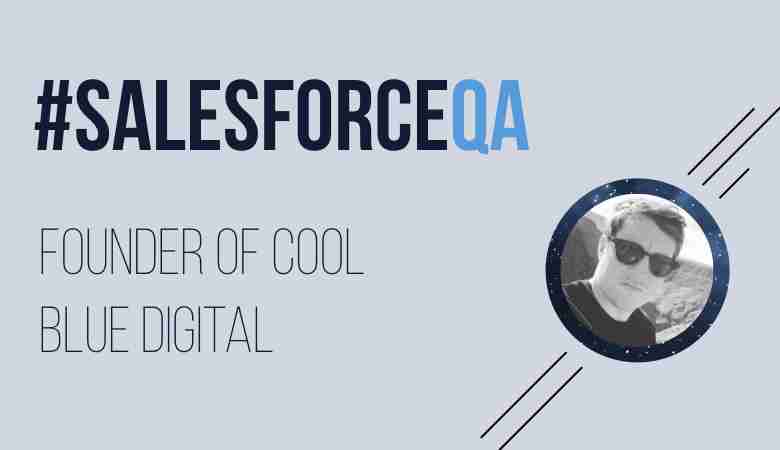
In our most recent #SalesforceQA, we caught up with Tobias Franklin, Salesforce Consultant, Solutions Architect and Founder of Cool Blue Digital.
Tobias talks about the benefits of starting a new player in the Salesforce market as well as how to maintain and grow company culture in a remote working environment. Tobias also imparts his top tips for those looking to start their own business in the Salesforce ecosystem.
Third Republic (TR): Could you talk us through the beginning of your career and how you got started in the ecosystem?
Tobias Franklin (TF): I started off as an admin at an American based startup in London (livingsocial). It was a crazy few years, pre-trailhead, and pre-certifications. Any help back then came from forums and mostly Steve Molis (big shout out Stevemo!) We only had workflow rules and apex back then so building a solution to a problem wasn’t as slick as it is today.
Outgrowing the admin role after about 3 very fun years at livingsocial, I worked my way through the ranks, always focussing on being the best I could at turning requirements into a top product.
I worked at a few Consultancies, I was a tech lead at Matches Fashion where I had a team to build some really exciting tools and products with, and then finally I started my own consultancy Cool Blue Digital after a little push from a friend of mine Grant Roessler.
TR: You are the Founder and Owner of Cool Blue Digital, a Salesforce Consultancy; what are some of the benefits of starting a new player in the Salesforce market?
TF: As a small business it’s quite hard to pick up the big projects you might have been part of as an employee. But there are plenty of small bits of work out there that you can deliver. You also make contacts from working all over the Salesforce ecosystem and build yourself (one hopes) a good reputation for delivering quality work, on time. From all this you gradually sustain and grow a small Salesforce business. You also get to do a bit of everything, which is great fun!
TR: In contrast to that, what are some of the challenges you have faced, when starting a Salesforce Consultancy and how did you overcome these?
TF: When starting you are always going into the unknown, in fact next month is still the unknown even a year later, but if you trust yourself and you know your worth then the universe shall deliver.
It’s important to ensure that you have made all the mistakes you possibly can before going out there solo. When you are running a business you don’t want to be making those mistakes you made as an early admin on your clients time and on your companies name!
TR: With the current working environment being remote, and lots of people working from home, has this impacted how you run your business day-to-day?
TF: I actually really like this setup and I know the IT sector has been asking for it for years. I get a lot more work done each day mainly because I am avoiding 2hrs a day on the train and the reduced stress of that commute. So in the day I can focus on my work, join a few video calls, and listen to some banging music (neighbours tolerance for ‘Amyl and The Sniffers’ permitting).
I think we should move to 2 days a week on site in the future. Its important we keep interacting with people face to face but it’s also unnecessary for us all to rush to an office for 9am. Better to enjoy our homes, save the environment a bit with reduced travel and finish work the moment our computers hit ‘sudo shutdown 17:00’.
TR: What are some of the things you do, as a company, to maintain and grow company culture during this remote environment?
TF: I just make sure everyone keeps talking, keeps having fun and heads outside for their lunch breaks. Its actually very easy not to move ALL day when you are working from home and its important that we get out and move about in the day. Especially given the desk nature of our work!!
TR: What are your top 5 tips for others looking to start their own business in the Salesforce ecosystem?
TF: 1. Make sure you are good at what you do – get some advice from others on this.
2. Ensure some recruiters know of your intentions before you make the leap as they may recommend you for some contract work.
3. Have all your legal stuff done before you pitch/look for work e.g. companies house registration, vat registration, accountant, business account.
4. Have enough money in the bank for at least 6 months of no to low income – you might not need to access any of it but I prefer the comfort of knowing it’s there should you need to draw down on it.
5. Always be positive and say yes – its important to take a chance and build relationships, you never know when that small piece of work turns into a recommendation for you and a 6-month stint somewhere else.
TR: In your experience what are some of the key traits that you need in order to succeed in the Salesforce ecosystem?
TF: In no particular order;
- rock solid communication skills
- confidence in your ability to make a clean working solution
- an ability to understand quickly how different businesses work/operate
- never beaten by a puzzle
- logical in how you break down a problem and build up a solution
- never afraid to get someone’s opinion on something (ensuring you are asking the right people when this time comes)
- when you get a good feel for which part of Salesforce you sit best in, become a master in that area – you can’t be absolutely everything to everyone in Salesforce even though people might want you to be
TR: You also have your own blog, could you tell us a bit about that?
TF: I was intending to start a blog and to be honest it took me a few years to get round to it, but I try to post about once a month now about a topic that I think is both useful and also not something I have seen covered on the other main Salesforce blogs;
You can check my blog out at https://salesforceconfig.com/ (yes it can load slowly sometimes)
TR: Do you think running your own blog has helped your career success in Salesforce?
TF: It’s impossible to say but I think it is a great way to hold a portfolio of some of your work and showcase it so that should anyone ask, you can send them the link or fire it up there and then and show them what you’re capable of!
TR: In your opinion, how important is the Salesforce community to career advancement?
TF: Of course, it’s super important for everyone to be able to share ideas, solutions, and just meet up with like-minded people.
TR: Finally, what are your predictions for the future of Salesforce? And what are you hoping to see?
TF: I remember thinking about this about 10yrs ago, and I thought Salesforce would be a solid career choice for at least the next 5yrs. Well clearly it will be a great career choice for anyone probably for the next 20+ years!
It’s impossible to see where it will go but I would love to be able to build automations in Salesforce that controlled systems in real-life. For example, you have seen automated warehouses such as those used by Amazon. I’m sure in the near future we will be designing the software in something a bit like Salesforce. Not only will the sales exist digitally in Salesforce as they might now, but Salesforce will be controlling the hardware in the warehouse and sending the instructions out to the delivery drones that deliver our parcels to our porches. It all exists, Salesforce just needs to join it all up.
If you’re a Salesforce professional and would like to join Tobias Franklin, in our Q&A series, please get in touch with us today!


