
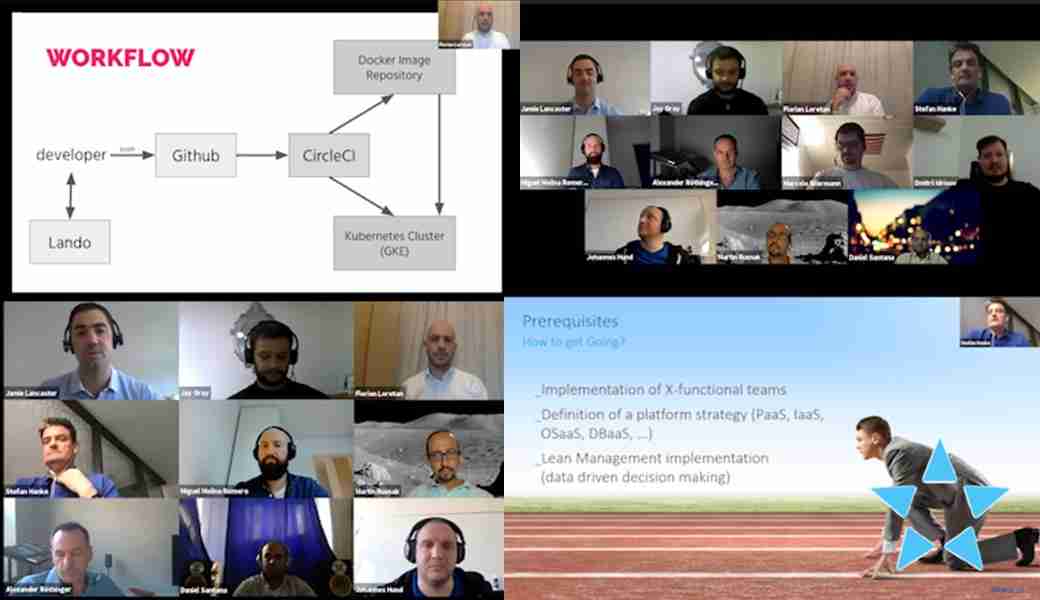
Following the success of our #CTORoundtable series, at the end of September we hosted our first Munich CTO Roundtable virtual event! The aim of this meetup was to bring together technology thought leaders to discuss trends in technical leadership, best practices, and movements in the tech market.
There were some interesting insights shared between our speakers and the discussion sessions in the event, into how technology leaders can motivate and maintain the happiness of their developers as well as best practices when implementing a move from application management to DevOps.
Boosting Developer Happiness with DevOps
For the first talk of the evening, Florian Loretan, Chief Technical Officer at Wunder spoke about how to utilise DevOps to boost the happiness of developers in your tech team. Florian drew his advice from what he had taken away from two books, the first was The Phoenix Project, a story of a developer project gone wrong. From this book, Florian highlighted the three ways of DevOps methodology; the first way is that work only flows downstream. This emphasises the need to minimise the flow of work within your organisation as much as possible. The second way is to create, shorten and amplify feedback loops. Thereby, looking for better ways of doing things and addressing the issues within your organisation. The final way of DevOps is continued experimentation; looking for new ways to generate value and improve the overall system, not just from a technical perspective.
How does this relate to happiness? Florian made the interesting point, that in a work context, happiness correlates to motivation.
Having motivated developers is key for any business as they are more focused and engaged with the organisation. To achieve this, Florian spoke about his learnings from the second book: Drive. The three elements that motivate developers are: autonomy, mastery and purpose.
Giving the developers in your tech team autonomy will improve their happiness as people like to have control over their actions and choices. Florian comments that an easy to make developers unhappy is to restrict their choices on what software and tools they can use. Mastery plays a key role in the motivation of developers. Developers care about their craft; they aspire to be proficient in coding and creating good quality outputs. Indicating the difference between junior and senior developers, Florian suggests that whilst junior developers may care about the ‘cool’ technology they are using, as developers progress in their career their purpose shifts towards the impact that they are making through the technology.
Watch the full video here, to discover how they put this theory into action at Wunder using a system called Silta (the Finnish word for bridge).
Putting the concepts of both books together, Florian highlights the alignment between the three ways of DevOps methodology, and the key drivers of motivation. This is something that for Florian, has evolved over time when creating their system at Wunder, with the aim of facilitating the developer experience as opposed to focusing on the operational side of the organisation.
Managing the Bi-Modal Challenge
The second talk of the evening was given by Stefan Hanke, former Head of Service Reliability Engineering at Amadeus, and focused on best practices for making the move from application management to DevOps.
Drawing on personal experience, Stefan talked about the move that had been implemented at Amadeus. Beginning with how they started the journey, Stefan highlights that the first step they took was to change from classical functional teams to cross-functional teams; creating end-to-end IT service accountability per team. This caused challenges for people within the organisation who were used to having subject matter experts and deep expertise straight in the team – whereas now people’s skills where centred around the requirements to manage an IT service in production. Whilst this was considered a basic step within the move, Stefan emphasises the challenge of changing the job profiles of more than 1,000 people.
The second step was to define platform strategy. Moving away from an application stack based handling of topics, to a platform strategy in terms of defining Iaas, PaaS, and services such as OSaaS and DBaaS. This was done to centralise to a service offering to both the developer and operations community, and only include the app specific elements of these within the teams.
The third step was to put into action lean management, with a particular focus on data driven making decisions. Stefan emphasises the need to bring people in the team onto the process of defining KPI’s so that they matter to the individuals and customers. Creating a culture where they are bought into dashboards and operational reviews to start the continuous improvement process – based on facts.
Stefan indicts that the main challenges when moving to DevOps, for the company, related to the skillset they had in the organisation at the time, as well as the maturity of their process. They needed to define the building blocks of the transition, reducing ambiguity, and providing guidance to the teams.
An important aspect for Stefan was getting the team to not think too much of DevOps as a mindset change but into the idea of making that pragmatic first step. To achieve this the organisation created ‘pilot teams’, that would begin to share backlogs; feature loads, operational loads etc. Building this combined team allowed people to understand and ‘share the mission’. Along with this the responsibilities and accountabilities for these teams were redefined.
Watch the full event talk here, to hear Stefan talk more about the ‘ceremonies’, ‘roles’ and ‘artifacts’, that were put in place to provide guidance and tools for the team.
For the day-to-day operations were split into two groups: Continuous Improvement and Automation SCRUM and the Operational SCRUM. The CIA SCRUM, focused on continuous improvement and thought from a productivity mindset, whilst the operational SCRUM managed daily activities.
Measuring the success of this transition was a big requirement for Stefan, from perspectives of both the internal organisation as well as the customers – highlighting productivity and improvement. The categories used in the dashboard to measure this were: Initiative KPIs, Team Agility KPI, DevOps KPIs, Business KPI, People-related KPI.
Thank You
I’d like to thank everyone who attended, the first event was a great success and we are already in the process of planning number two!
If you are interested in speaking at our next event, or attending one don’t hesitate to contact Third Republic or even the host Jamie Lancaster directly.


