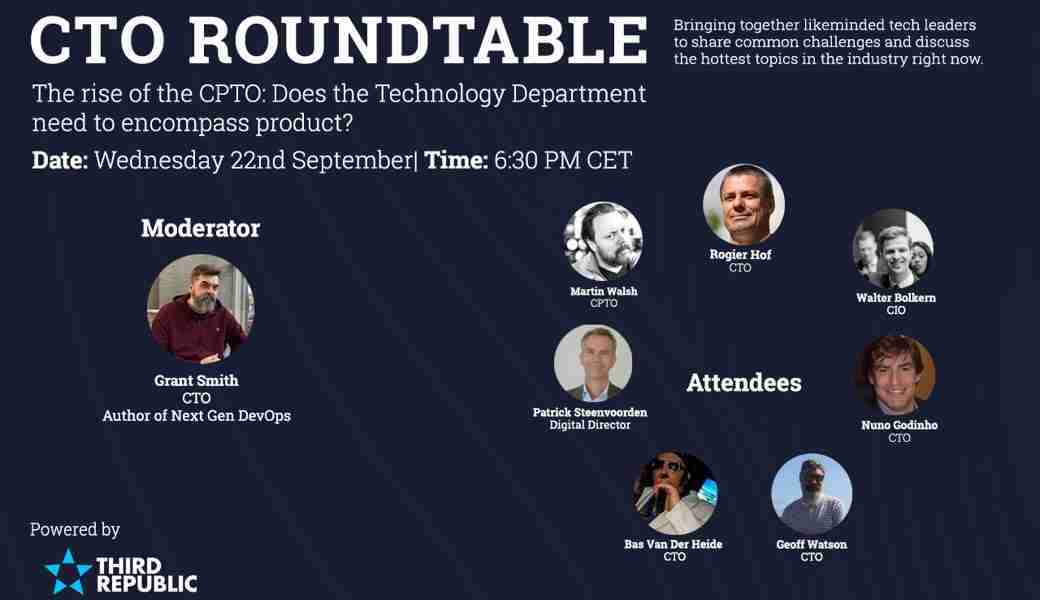
CTO Roundtable – Rise of the CPTO

As the role of CPTO becomes more prevalent, is there an expectation for technology to encompass product? If so, how does the CTO align the natural ambiguity of software development make work for Marketing who demand dates and certainty?

We recently held another one of our CTO Roundtable events, this time discussing the rise of the CPTO. It was great to have a mix of attendees with diverse backgrounds and routes into technology attend the discussion. Present were participants from large enterprises, growing concerns and start-ups, with positions ranging from technical, engineering and product backgrounds.

Does the Size of an Organisation Play a Part?

The discussion started with a speculation about how an organisation’s size might impact the choice of whether to have a CTO and a CPO. There was also a recognition that as a company grows so might its board grow, which might provide an opportunity for an extra board seat that could potentially be occupied by a full-time CPO.

What about the Business Lifecycle?

We then moved on to analyse whether the stage of the business lifecycle would have an impact on the decision to choose a CPTO. It was noted that a business focused on innovation might choose to have a CPO, who would be more focused on discovery of new opportunities, whereas a business that was trying to exploit its assets may prefer a CPTO to focus in on KPI improvement.

Let’s Talk About the Product

Innovation can either come from discovery of customer needs or from exploration of new technical capabilities, and this difference in focus could also influence whether a CPO or a CPTO would be more valuable to an organisation.

One attendee, who was familiar with med-tech, highlighted that the presence of clinical leadership offered an additional tension to the CPO and CTO and that in those circumstances it might make more sense to collapse the CTO and CPO roles together so that the CPTO could work directly with the Chief Medical Officer (CMO) to prioritise initiatives. Afterall: “In politics, the tripod is the most unstable of all structures”.

 It was mentioned during the conversation that in some instances the product function tended to ignore the “ilities” which, in some industries, are far more important than new features and might make a product role less attractive to successful product leaders.

Transitioning from CTO to CPTO

Several attendees were CPTOs and as part of the conversation, it became clear that there was a very consistent theme to transitioning from the role of CTO to CPTO.

For example:

‘The business is struggling to get products launched and concludes that there are problems with their technology function so hire a CTO. The CTO joins the organisation with the mission to “fix technology”. Invariably they find areas where they can bring improvement but discover that the problem is actually in product management. Products are poorly specified, or product managers are struggling to communicate their requirements to the development teams. The CTO, being a systemic thinker, decides to bring product and technology together under one leader who can provide both functions with clarity of purpose and prioritisation. Thus a new CPTO is born.’

Variations of this story were told repeatedly.

Is the CPTO Role Evolved from Circumstance?

Given the nature of the discussion it seemed pertinent to consider whether the CPTO role must always evolve or whether it is now being created in organisations. While all the CPTO attendees had evolved their roles, it was noted that CPTO roles are starting to be advertised. This led to the concern that a CPTO was not a panacea.

However, collapsing two essential functions into a single role isn’t a guaranteed recipe for success. Let’s not forget the ill-fated Digital Transformation Officer that was fashionable for a while.

Team Structure

It was broadly agreed that the CPTO role must switch their focus from one discipline to another and back again, which can become disorienting. Invariably all the CPTOs in attendance emphasised that, as in all leadership roles, the key to success is having a good team supporting them and each other.

The team must be able to operate with autonomy while the CPTO turns their attention to one function or another or indeed outside the business to work with investors or stakeholders from parent or partner organizations.

One of the attendees had noted that the design function also reported to them. It was speculated that once product and technology were no longer limiting factors, design would be the next bottleneck. It was also highlighted that design is no longer just digital graphic design, the role has grown into product design where designers become specialists not just in user interfaces (UI) but also user experience (UX), voice of the customer and user research. The synergy between a modern product designer and a product manager makes them a natural fit into a CPTO’s organisation. With the emergence of the product marketing function, product management is also evolving.

A final thought: If the CPTO is going to take on technology, product and design where does it stop? The answer is where the value stream stops. With a CPTO in post, the board can provide resources to a single individual to manage the total value stream removing the budget negotiation that, for so long, absorbed so much leadership time.

If you are interested in speaking at our next event, or attending one don’t hesitate contact Third Republic or even the host Adam Elliott – Smith directly. 

More Insights

Benjamin Hanrieder

Q&A Benjamin Hanrieder (CTO, Engel & Volkers)

In this interview, Benjamin Hanrieder, CTO at Engel & Völkers Technology, discusses the company’s digital transformation, software development practices, and the role of the Cloud Platform Team in ensuring reliable and secure infrastructure. Mat Roche (MR): Can you give us an overview of your background?  Benjamin Hanrieder (BH):  Hi Mat,

Read more >

Get In Touch

Fill out the form below, and we will be in touch shortly.

Seniority

Software Developers
Senior Engineers
Software Architects
Senior Software Architects
Software Tech Leads
Senior Software Tech Leads
Software Tech Lead Managers
Senior Software Tech Lead Managers
Director of Engineering
VP of Engineering


Software Developers
Senior Engineers
Software Architects
Senior Software Architects
Software Tech Leads
Senior Software Tech Leads
Software Tech Lead Managers
Senior Software Tech Lead Managers
Director of Engineering
VP of Engineering


Software Developers
Senior Engineers
Software Architects
Senior Software Architects
Software Tech Leads
Senior Software Tech Leads
Software Tech Lead Managers
Senior Software Tech Lead Managers
Director of Engineering
VP of Engineering


Role

Full-stack Developers
Back-end Developers
Front-end Developers
DevOps Engineers
SRE Engineers
Cloud Engineers
Platform Engineer
Security Engineers
Mobile Developers
App Developers
No1 software engineers

Full-stack Developers
Back-end Developers
Front-end Developers
DevOps Engineers
SRE Engineers
Cloud Engineers
Platform Engineer
Security Engineers
Mobile Developers
App Developers
No1 software engineers

Full-stack Developers
Back-end Developers
Front-end Developers
DevOps Engineers
SRE Engineers
Cloud Engineers
Platform Engineer
Security Engineers
Mobile Developers
App Developers
No1 software engineers

Skills

React.js
Node.js
AWS
JavaScript
React
Native
PostgreSQL
Ruby on Rails
Java
Angular
Golang
PHP

React.js
Node.js
AWS
JavaScript
React
Native
PostgreSQL
Ruby on Rails
Java
Angular
Golang
PHP

React.js
Node.js
AWS
JavaScript
React
Native
PostgreSQL
Ruby on Rails
Java
Angular
Golang
PHP

Sample By Job Family

Data Scientists
Data Engineers
Data Architects
Data Modelers
BI Developers
Data Analysts
Data Quality Engineers
Data Governance Experts MLOps Engineers
DataOps Engineers
Data Product Managers
Executive Data Leadership

Data Scientists
Data Engineers
Data Architects
Data Modelers
BI Developers
Data Analysts
Data Quality Engineers
Data Governance Experts MLOps Engineers
DataOps Engineers
Data Product Managers
Executive Data Leadership

Sample of Platforms & Tools

Cloud DW: Snowflake, BigQuery, Redshift ETL/ELT Tools: Airflow, dbt, Fivetran, Talend Big Data Frameworks: Spark, Hadoop, Kafka BI & Visualization: Tableau, Power BI, Looker ML Libraries: TensorFlow, PyTorch, Scikit MLOps Platforms: MLflow, Kubeflow, W&B Data Governance: Collibra, Alation Data Observability: Monte Carlo, Databand Data Lakes: Lake Formation, Delta Lake SQL/NoSQL DBs: PostgreSQL, MongoDB Real-time Analytics DBs: Apache Pinot, Druid Gen

Cloud DW: Snowflake, BigQuery, Redshift ETL/ELT Tools: Airflow, dbt, Fivetran, Talend Big Data Frameworks: Spark, Hadoop, Kafka BI & Visualization: Tableau, Power BI, Looker ML Libraries: TensorFlow, PyTorch, Scikit MLOps Platforms: MLflow, Kubeflow, W&B Data Governance: Collibra, Alation Data Observability: Monte Carlo, Databand Data Lakes: Lake Formation, Delta Lake SQL/NoSQL DBs: PostgreSQL, MongoDB Real-time Analytics DBs: Apache Pinot, Druid Gen

Sample of Skills Delivered

Programming in Python, R, and SQL
Python
Data Modeling Statistical
Analysis ETL/ELT
Pipeline Development
Database Design & Administration
Machine Learning Fundamentals
Cloud Data Warehousing
Data Ethics & Compliance
Data Security
Data Visualization & Storytelling
Real-Time Data Streaming

Programming in Python, R, and SQL
Python
Data Modeling Statistical
Analysis ETL/ELT
Pipeline Development
Database Design & Administration
Machine Learning Fundamentals
Cloud Data Warehousing
Data Ethics & Compliance
Data Security
Data Visualization & Storytelling
Real-Time Data Streaming

Sample By Job Family

AI Software Engineers
Gen AI Engineers
Machine Learning Engineers
Deep Learning Engineers
Prompt Engineers
AI Research Scientists
NLP Engineers
Computer Vision Engineers
MLOps Engineers
AI Product Managers
AI Governance Specialists
AI Ethics Office
AI Architects Executive

AI Software Engineers
Gen AI Engineers
Machine Learning Engineers
Deep Learning Engineers
Prompt Engineers
AI Research Scientists
NLP Engineers
Computer Vision Engineers
MLOps Engineers
AI Product Managers
AI Governance Specialists
AI Ethics Office
AI Architects Executive

Sample of Platforms & Tools

LLMs: Open AI, Anthropic, Llama, Gemini ML Platforms: SageMaker, Vertex AI, Azure ML ML Libraries: scikit-learn, XGBoost, LightGBM DL Frameworks: TensorFlow, PyTorch, Keras LLM Frameworks: LangChain, LlamaIndex Vector Databases: Pinecone, Weaviate, Milvus Data Science Notebooks: Jupyter, Colab, Kaggle Data Visualization Libraries: Matplotlib, Seaborn NLP Libraries: Hugging Face Transformers CV Libraries: OpenCV, Pillow, Albumentations MLOps Tools: MLflow, Kubeflow, W&B

LLMs: Open AI, Anthropic, Llama, Gemini ML Platforms: SageMaker, Vertex AI, Azure ML ML Libraries: scikit-learn, XGBoost, LightGBM DL Frameworks: TensorFlow, PyTorch, Keras LLM Frameworks: LangChain, LlamaIndex Vector Databases: Pinecone, Weaviate, Milvus Data Science Notebooks: Jupyter, Colab, Kaggle Data Visualization Libraries: Matplotlib, Seaborn NLP Libraries: Hugging Face Transformers CV Libraries: OpenCV, Pillow, Albumentations MLOps Tools: MLflow, Kubeflow, W&B

Sample of Skills Delivered

Generative AI Development
Machine Learning Algorithms
Deep Learning Architectures
NLP and NLG
Computer Vision
Data & Feature Engineering
MLOps & Model Deployment
Statistical Analysis & Hypothesis Testing
Python and R Programming Expertise
Model Evaluation & Performance Tuning
AI Governance & Compliance
Autonomous AI Agent Engineering
Building Agentic AI Applications

Generative AI Development
Machine Learning Algorithms
Deep Learning Architectures
NLP and NLG
Computer Vision
Data & Feature Engineering
MLOps & Model Deployment
Statistical Analysis & Hypothesis Testing
Python and R Programming Expertise
Model Evaluation & Performance Tuning
AI Governance & Compliance
Autonomous AI Agent Engineering
Building Agentic AI Applications

